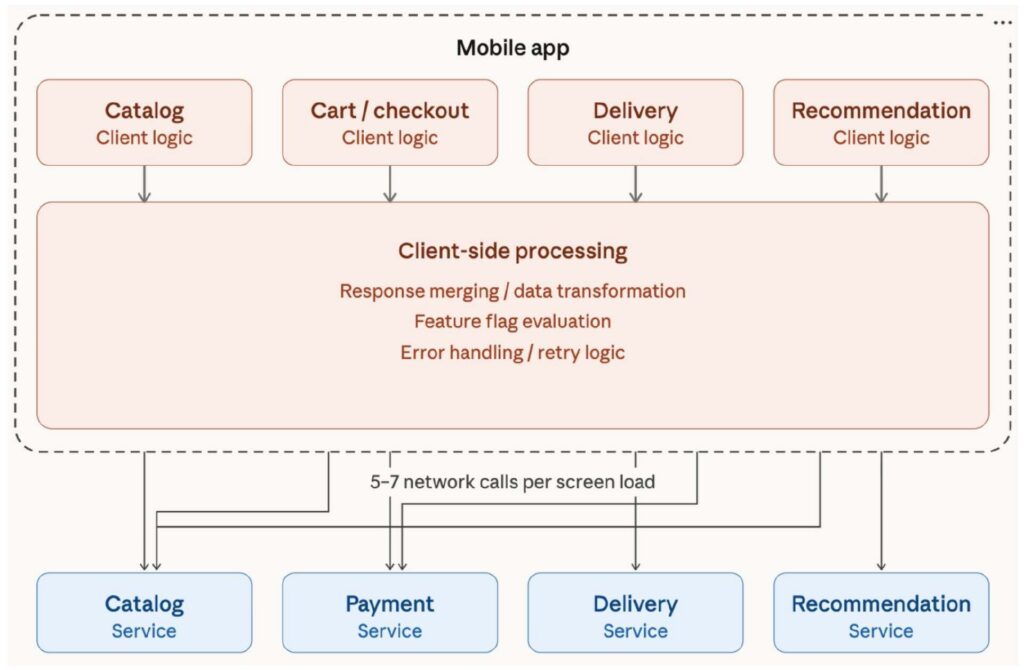
Reported by InfoQ on November 13, 2026. This is an account of one team’s architecture and migration, not a benchmark for other apps.
An engineer who worked on a large e-commerce platform describes moving backend coordination out of its Android and iOS apps and into a gateway between the apps and hundreds of backend services. The aim was to reduce work on users’ devices and make some product changes without waiting for an app-store release.
Before the change, the apps called multiple services for each screen, combined responses locally and handled service-specific errors. According to the engineer, a product-detail page could require five or six service calls. On midrange Android devices—which the engineer says represented about 60% of the platform’s users—the page took 2.8 seconds to render, including roughly 1.1 seconds of network time and 0.9 seconds of client-side data transformation. App cold starts had exceeded four seconds.
The gateway instead assembled screen data on the server, applying feature flags and handling downstream failures before returning a response the app could render with less processing. The team chose a hybrid form of backend-driven UI: the gateway controlled sections, ordering, visibility and experiment variants, while the app retained control of component rendering. Existing sections could be reconfigured from the server, but adding a new section type still required an app update and a compatible server–client contract.
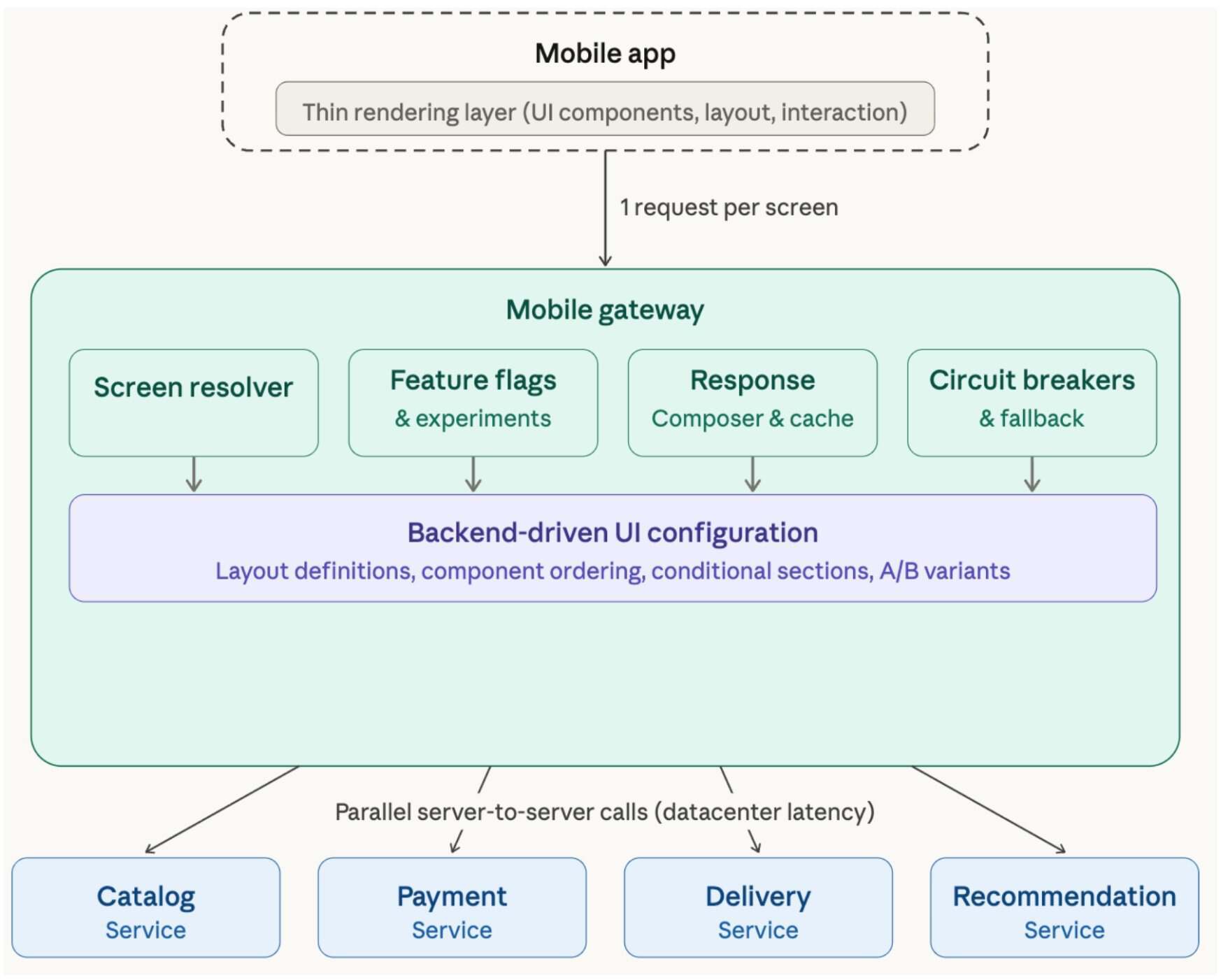
The engineer says the migration proceeded screen by screen. The team first ran the gateway alongside the old path and compared responses. Once differences fell below 0.1%, it sent 1% of traffic to the new path and monitored it for at least 48 hours. Traffic then rose through 5%, 25%, 50% and 100% over one to two weeks per screen, with an automatic return to the old path if its error rate exceeded the baseline by more than 0.5 percentage points. The old client integration was removed after four stable weeks at 100% traffic.
The trade-off was a new critical dependency. The engineer reports an additional gateway hop of about 5–15 milliseconds within the same data center and says the team deployed across availability zones with a 99.99% availability target. It also classified downstream data as required, recommended or optional so the gateway could follow predefined fallback rules during failures. The account does not provide post-migration page-load measurements, so the performance improvement cannot be quantified from the published text.
Source: infoq.cn (originally published 2026-11-13 13:00 UTC+8)