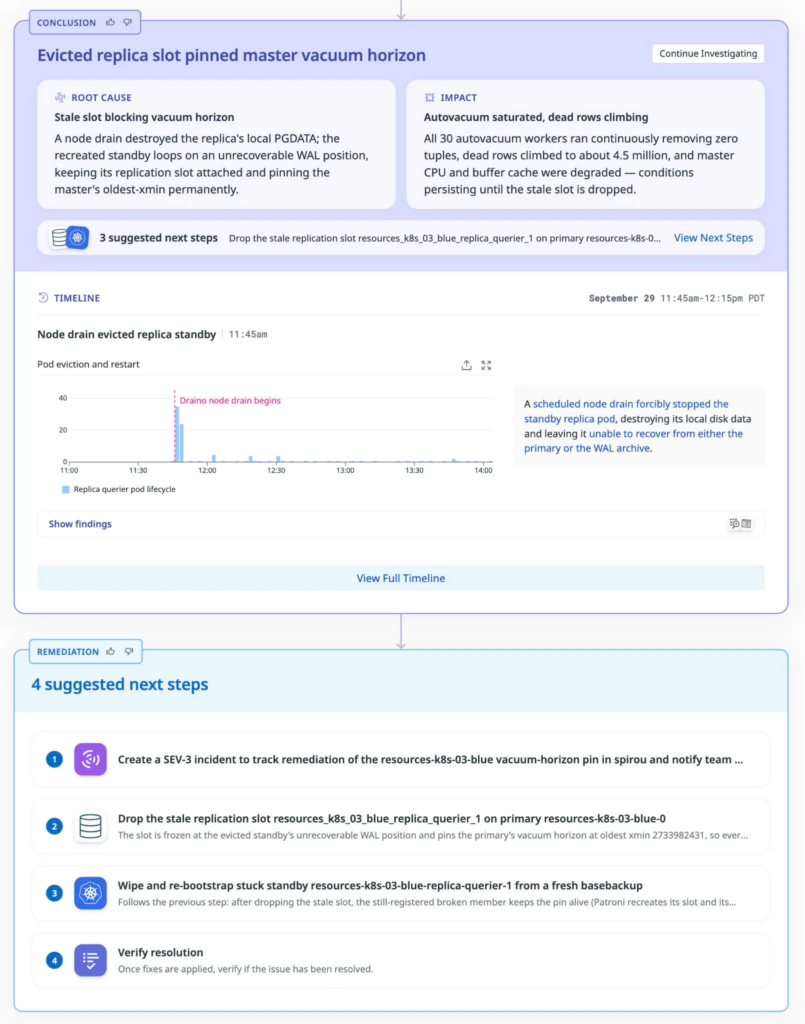
Datadog has introduced Scout, a model for investigating production incidents in Bits Investigation, its AI SRE product. Scout can receive an alert, examine telemetry and suggest a likely root cause. Datadog engineers and a small number of customers are using it in a closed preview; the company has not announced a general release date.
Datadog says cost is a central reason for building a specialized model. An investigation can require repeated model calls as Bits queries data, assesses the results and decides what to inspect next. The company wants Bits to begin investigating every alert while an engineer is still responding—something it says would be too expensive with general-purpose models.
What Datadog tested
On Datadog’s AlertEval benchmark, the company reports that Scout medium scored similarly to GPT-6.1 Sol high and Claude Opus 5.5 high, at an estimated inference cost of one-third to one-eighth as much. Datadog also says Scout xhigh performed comparably to Claude Fable 5.1 xhigh at one-quarter of its cost. It has not published specific prices; the cost figures are relative to a Scout medium investigation.
AlertEval compares model reports with incident reports written by Datadog engineers, using real alerts and archived telemetry. An LLM judge scores agreement on immediate and root causes and penalizes contradictions or unsupported claims. Datadog cautions that a score out of 100 is not the percentage of incidents successfully resolved.
In a separate Datadog-run evaluation on SREGym’s 90 incident scenarios, Scout resolved 71 cases at medium, 79 at high and 80 at xhigh. GPT-6.1 Sol xhigh resolved 82. Datadog conducted all the tests, including those of competing models; independent testing would provide a stronger check on the results.
How Scout was trained
Scout is built on GLM-5.3 Flash. Datadog says it used reinforcement learning to post-train the model on simulated incidents derived from patterns in historical cases, and that those training materials contain no customer data. The simulations include alerts, queryable telemetry and known root causes. Scout practised with tools simulating searches across logs, metrics and traces, as well as checks of code, deployments and feature flags.
Datadog’s technical report describes a training problem: rewarding only the final conclusion encouraged Scout to stop investigating early and avoid potentially penalized inferences. The team changed the rewards to account for correctness, exploration and supporting evidence. In some training runs, it also removed tools or shortened the available time to discourage a fixed investigation path.
Scout is part of a broader push to use AI in incident response, but the extent of automation varies by product. For now, Datadog says Scout investigates, diagnoses and suggests recovery steps. Engineers remain responsible for making changes. Datadog’s longer-term goal is for Bits to carry out remediation, but that capability is not part of the current preview.
Source: infoq.cn (originally published 2026-11-11 17:00 UTC+8)