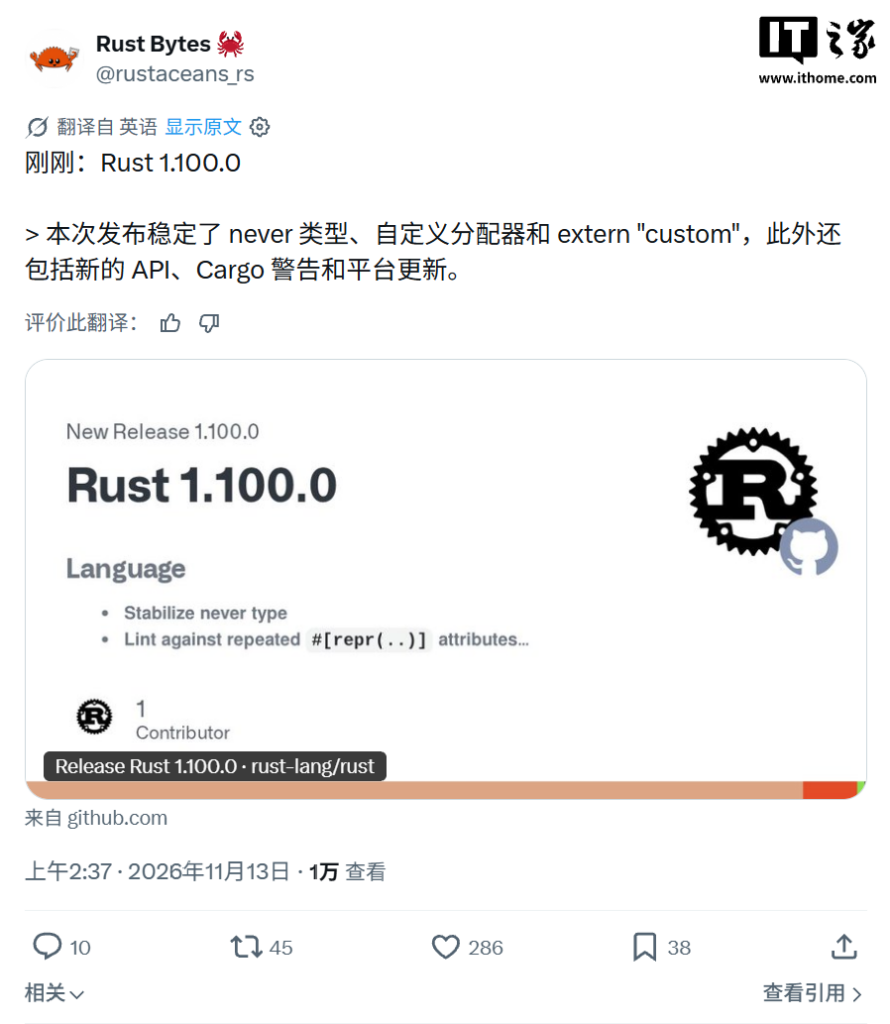
Rust 1.100.0 was released on November 12, 2026, according to a November 13 report by IT Home. It is the first Rust release with a three-digit version number. The update stabilizes several language and standard-library features and changes how Cargo handles dependencies and build caches.
The never type reaches stable Rust
The never type, written !, is now stable after roughly 10 years and five attempts at stabilization, according to the Rust team. It describes a computation that never produces a value, such as a return, break, or std::process::exit expression. Developers can now use ! explicitly in type positions, including Result<T, !>.
Infallible is now an alias for !. There is also a compatibility change to watch for: in the Rust 2015, 2018 and 2021 editions, the default fallback for the never type changes from () to !, which could affect some code.
Allocators and standard-library APIs
The release stabilizes core parts of the Allocator API. Developers can define custom allocators through the Allocator trait and use them with supported standard-library types, including Vec and Box. The Rust team plans to extend custom-allocator support to more collection and pointer types.
The standard library also gains core::mem::DropGuard, which runs a specified closure when a variable leaves scope. It can help with cleanup across normal returns, error propagation and panics. Another addition, std::mem::conjure_zst, provides a dedicated way to create zero-sized types when its safety requirements are met. It is an unsafe operation because creating such values incorrectly can violate API safety assumptions. Other stabilized APIs include comparisons involving Vec, slices and Cow, and custom-allocator support for Box, Arc and Rc.
Cargo dependency and cache changes
Cargo now warns by default about declared dependencies that are unused by the relevant build targets. It also applies build-configuration hashes more consistently to cache directories, reducing the risk of collisions between different configurations.
For supply-chain risk management, Cargo has stabilized min-publish-age. A project can set a minimum age for dependency versions in .cargo/config.toml, for example:
[registry]
global-min-publish-age = "3 days"
With that setting, Cargo skips dependency versions published less than three days earlier when resolving versions. The delay gives automated scanners and the community more time to identify malicious releases; an environment variable can override the limit for an individual update.
Users who installed Rust through rustup can update the stable toolchain with rustup update stable.
Source: ithome.com (originally published 2026-11-13 12:30 UTC+8)