Backfill: originally reported November 11, 2026.
Multi-cloud flexibility comes with a cost that may not be obvious from a provider’s advertised egress rate. In an InfoQ article, the author argues that service placement, synchronous calls and repeated data transfers should be treated as design decisions—not merely as charges to investigate after deployment. The article’s pricing discussion refers to provider rates checked as of January 2026; its benchmark uses published first-quarter 2026 pricing.
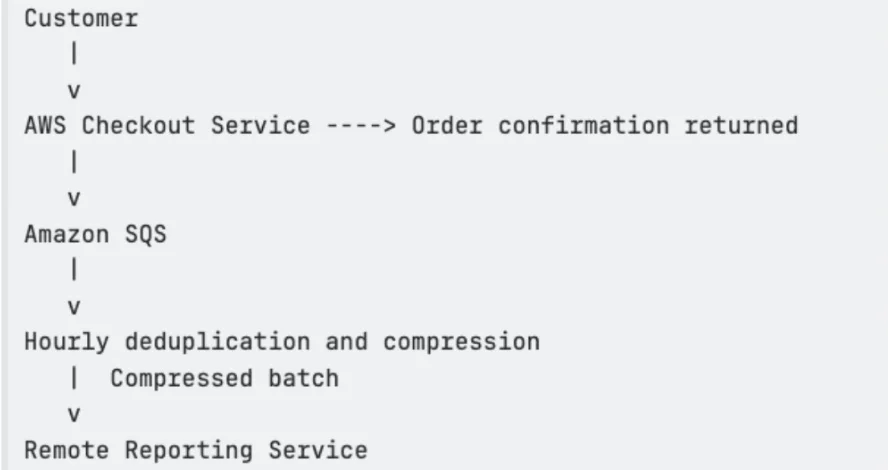
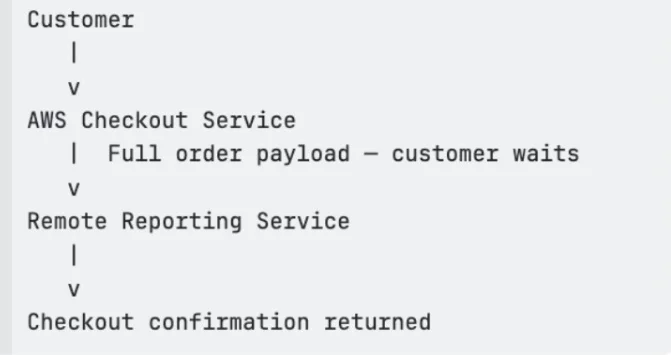
The author identifies four patterns that can increase avoidable traffic: synchronous requests that cross provider boundaries, continuous transfers for data consumed only periodically, moving raw data that will later be aggregated or discarded, and sending the same update separately to multiple cloud destinations. The suggested alternatives depend on the workload. A customer waiting for payment authorization may need a synchronous response; an hourly reporting system generally does not need to block checkout.
To test that distinction, the article describes a controlled simulation of 100,000 synthetic completed orders. Each produced an average 250 KB cross-cloud payload. Traffic ran for one hour at an average of 25 orders per second and a peak of 100; the simulated remote-service latency was 100–300 milliseconds, with two retries after a timeout or failure. The author then projected network costs for 100 million completed orders per month, comparing synchronous delivery of full orders, hourly batches of deduplicated and compressed records, and source-side calculation of dashboard metrics.
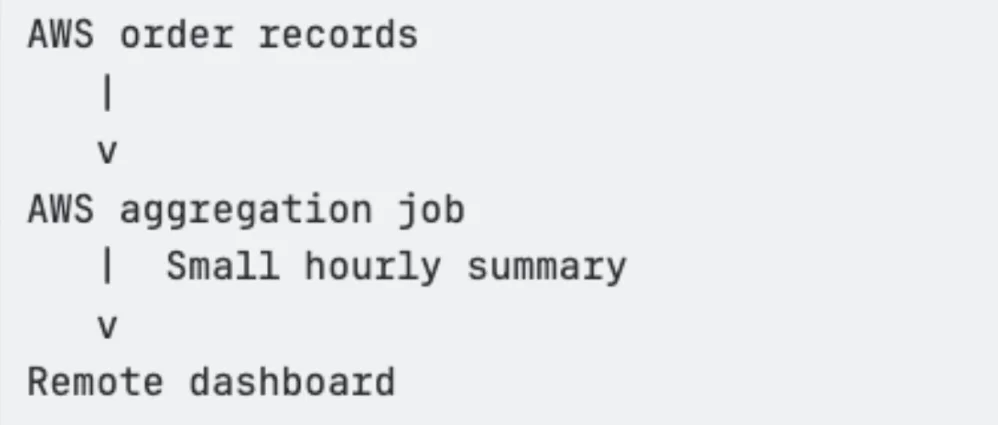
In that experiment, batching reduced transferred data by 60%, while source-side processing reduced it by 95%. Removing reporting from the checkout path lowered the reported 95th-percentile checkout response time from 420 to 145 milliseconds. Under the article’s illustrative rate of $0.135 per GB—including $0.09 for transfer and $0.045 for gateway processing—the projected monthly network cost fell from $3,375 for synchronous delivery to $168.75 for source-side processing, or approximately $38,475 in annual savings. These are results and projections for the described workload, not a general savings guarantee.
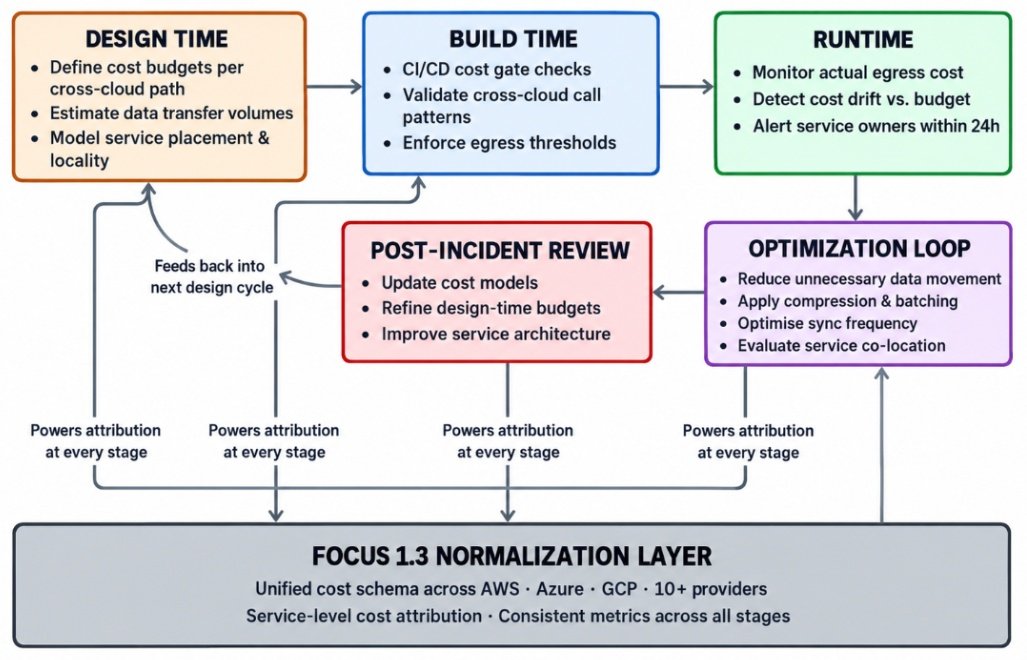
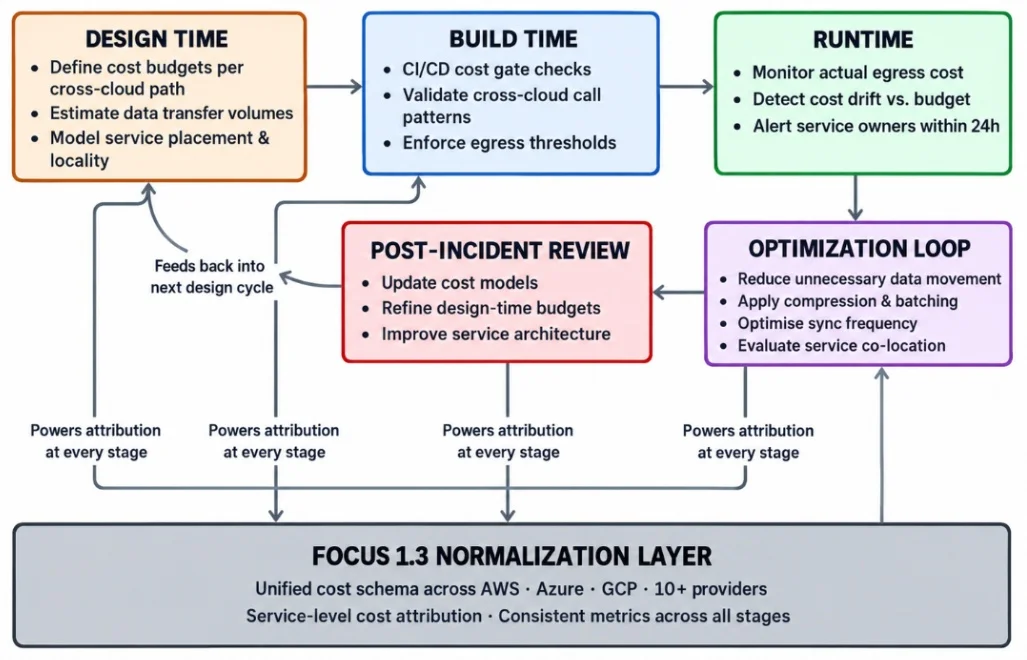
The proposed engineering workflow is to estimate cross-cloud traffic during design, check significant changes in CI/CD, monitor production spending and feed the findings back into architecture decisions. The author recommends standardizing billing data with FOCUS, while noting that standardized bills alone cannot identify which request, retry or fan-out caused a charge; teams would also need ownership tags, traces and network-flow logs.
Image and version note: The article text calls this a “FOCUS 1.4” normalization layer, but its lifecycle diagrams are labeled “FOCUS 1.3 NORMALIZATION LAYER.” The source does not resolve that discrepancy, so neither version is treated here as independently verified for the diagrams.
The practical starting point proposed by the author is to rank the largest cross-cloud egress paths, then ask whether each moves data in the right form, at the right frequency and across the right boundary. Workloads requiring immediate decisions or transaction-level records may still need synchronous or record-level communication.
Source: infoq.cn (originally published 2026-11-11 16:49 UTC+8)