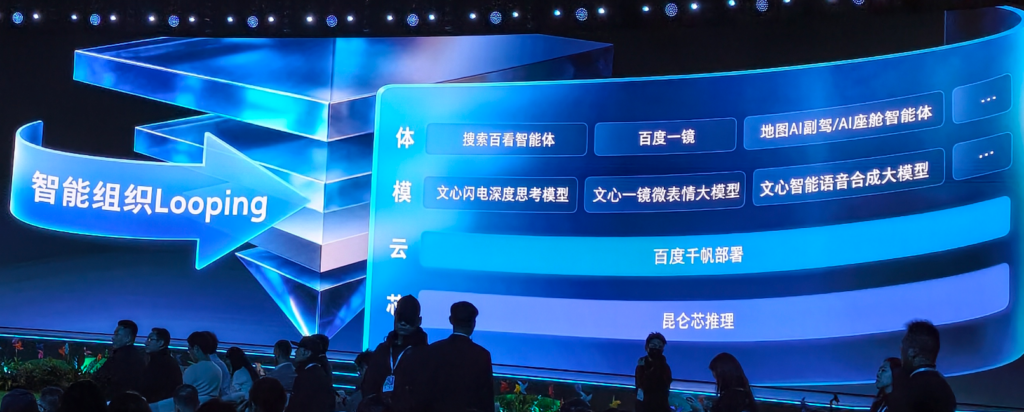
At the 2026 Baidu World conference, Baidu founder Robin Li raised a question for companies increasing their AI spending: why might token consumption rise without a corresponding gain in revenue or profit? His answer was that adding AI tools to existing work is not the same as redesigning how work gets done.
Li compared the situation with early factory electrification, when replacing power sources without reorganizing production lines did not immediately deliver the expected productivity gains. He proposed moving from fixed job boundaries toward tasks carried out by people and AI agents, making employees’ tacit knowledge reusable, and building workflows that measure results and improve through repeated cycles. These were Li’s proposals for organizational change, not evidence that the approach has improved companies’ profits.
Baidu reported that its internally active agents per day had grown from about 5,000 to 37,000 over the past year, while effective tasks completed per week rose from 84,000 to more than 1 million. It also reported more than 4,300 workspaces and over 20,000 organizational skills. Li acknowledged two problems in that transition: business units duplicated model-training work that soon fell behind newer base models, and teams spread resources across too many agent projects. Baidu subsequently centralized model training and began monthly reviews to narrow project priorities.
Lenovo chairman and CEO Yang Yuanqing, speaking with Li at the conference, described a complementary approach: company-wide AI planning alongside experiments by employees. He said Lenovo is using AI in areas including software development, sales, customer service and supply-chain demand forecasting. In his view, AI can inform forecasts and plans, but people still need to make decisions when changes affect purchasing, production and supply. Both executives said AI cannot yet replace the human relationship involved in a CEO meeting clients.
Baidu also presented products intended to put agents into business workflows. It said its upgraded Baidu Dazi assistant can connect to systems such as OA, ERP and CRM through its Harness engine and Agent API. In a Baidu-reported evaluation covering seven types of work and nearly 100 cases, its first-pass acceptance rate on complex tasks rose from 67.6% to 88.2%. Separately, Baidu said its FAMOU 3.0 offering would pair an agent platform with forward-deployed engineering services for industrial tasks.

For companies buying model access, Baidu introduced Ciyuansuo, a marketplace intended to verify model providers and monitor service quality. Baidu said the platform had more than 100 supplier resources and averaged over 50 million calls and 700 billion tokens a day after its first month. Those figures, like the product performance claims announced at the conference, come from Baidu.
The announcements also included ERNIE 5.5 Flash Preview, which Baidu described as a 280-billion-parameter model with 14 billion active parameters and a context window of up to 1 million tokens. On infrastructure, Baidu said its Kunlun M100 chip was on the market, while the M300 chip and a 1,024-chip Tianchi system were planned for 2027.
Taken together, the announcements show Baidu’s effort to link agents, models and computing infrastructure to its argument about organizational change. Whether that combination delivers measurable business returns remains a separate question from how many tokens or agents a company uses.
Source: infoq.cn (originally published 2026-11-12 10:45 UTC+8)