Pinterest has replaced its multi-stage clustering pipeline for inferring user journeys with a fine-tuned language model of 4 billion parameters. The company reports that email click-through rate rose by 1.1% and push-notification open rate by 1.3%.
The model no longer groups keywords into interests. It analyzes a user’s activity history, identifies longer-term goals, and sends those journeys into Pinterest’s existing recommendation infrastructure.
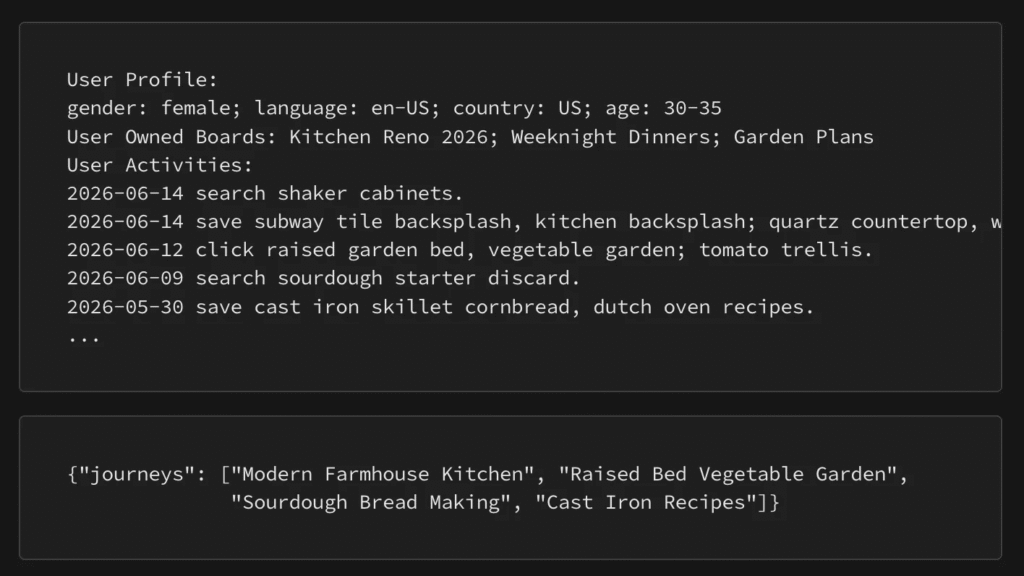
Pinterest defines a journey as a goal that spans multiple sessions and connects interests, intent, and context. Someone renovating a kitchen, for example, might search cabinet designs, save countertop ideas, and later look at backsplash tile or lighting. Together those actions point to one project rather than several unrelated interests.
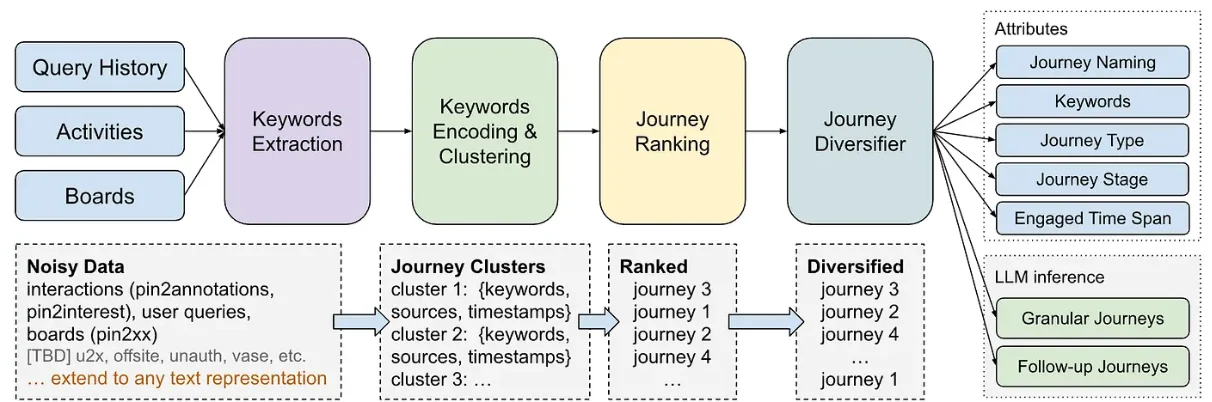
The earlier system extracted keywords from activity, grouped them with embeddings and hierarchical clustering, named the clusters, and ranked them with other models and diversity heuristics. Compared with older interest-based notifications, that method was effective, but it could split related activity into separate journeys, produce generic labels, or treat a one-off interaction as lasting intent.
The new system treats journey inference as a generation task. A fine-tuned large language model reads a chronological record of up to 150 user actions over 360 days, plus a condensed user profile, and generates prioritized journey names. Searches and saves are weighted more heavily than incidental clicks. The prompt asks the model to consider repeated interactions, recent behavior, and specificity.
Much of the ranking and filtering from the old pipeline has moved into the prompt. Instructions tell the model not to merge unrelated interests, to exclude one-off behavior and noisy auto-generated labels, and to return an empty result when there is not enough evidence of a meaningful journey. Pinterest treats changes to these instructions as production launches rather than simple prompt edits.
Lacking a large human-labeled dataset, Pinterest used frontier models to create synthetic training examples from activity histories. Those examples were used for supervised fine-tuning and low-rank adaptation (LoRA) of smaller open-weight Qwen3 models. The team tested models ranging from 600 million to 8 billion parameters and chose the 4-billion-parameter model to balance inference quality and serving throughput.
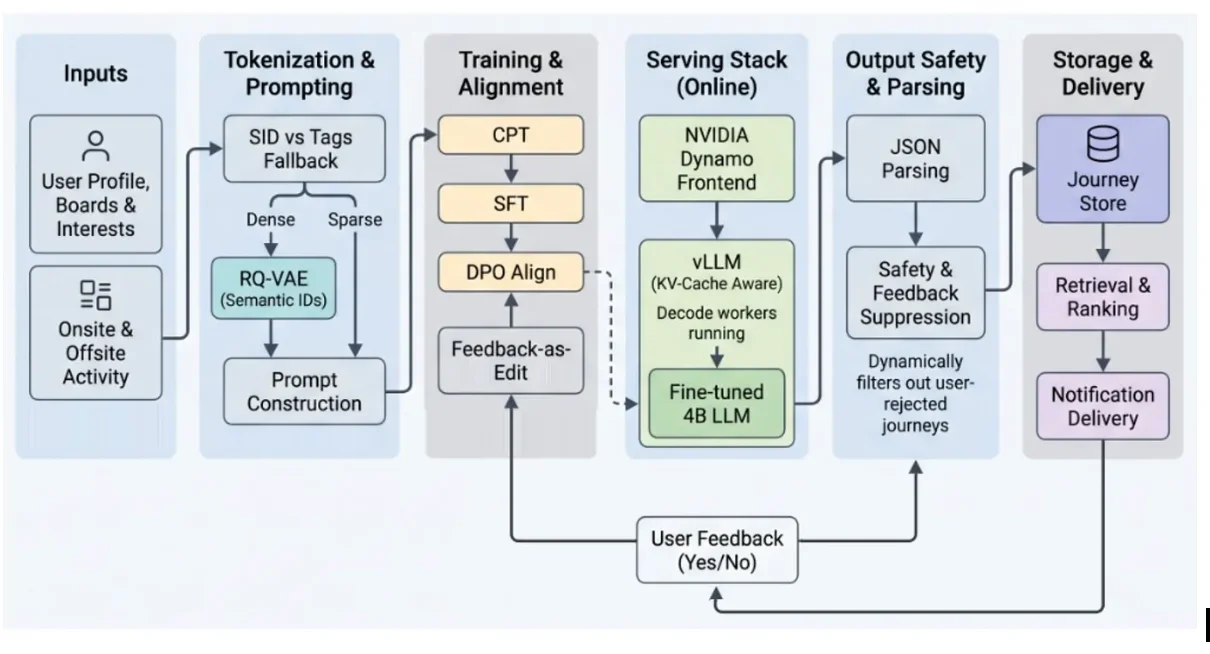
Serving the model at Pinterest’s scale added another engineering problem. The company deployed NVIDIA Dynamo in front of vLLM workers running on L40S GPUs, and used continuous batching, PagedAttention, and prefix-cache-aware routing to improve inference efficiency.
One of the largest throughput gains came from avoiding unnecessary inference. The system records when each user’s journeys were last generated and skips users already processed within the previous few days.
Pinterest evaluated journey quality with side-by-side comparisons, a separate large language model judging how relevant and well grounded each journey was in the user’s activity, and online experiments. Initial A/B tests in the United States and Canada showed the 1.1% email click-through and 1.3% push open-rate gains versus the clustering system. Engagement and retention metrics also improved by statistically significant amounts.
The approach resembles Netflix’s work on foundation models for personalized recommendations. Netflix has described learning from long sequences of user interactions to produce representations that downstream recommendation models can reuse. Netflix focuses on reusable preference representations, while Pinterest generates explicit journey descriptions. Both use longer behavioral histories to strengthen existing personalization infrastructure rather than replace it.