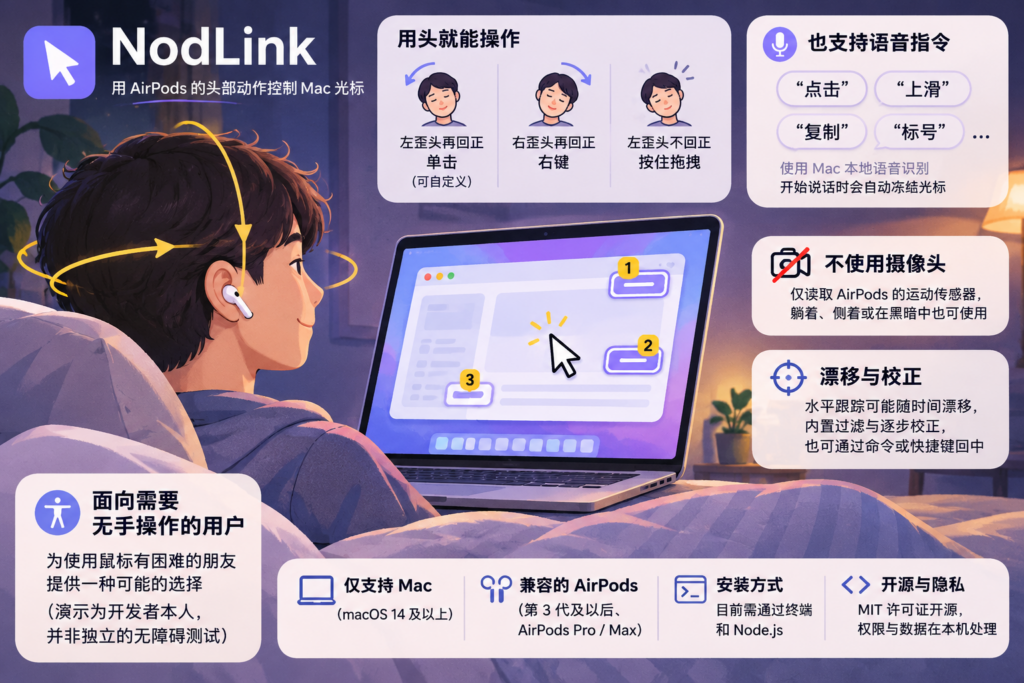
In a November 8, 2026 account, developer Uinui described NodLink, an open-source project that turns head movements detected by compatible AirPods into Mac cursor controls. It is intended to offer a hands-free option for people who find a mouse difficult to use, though the demonstrations are the developer’s own, not an independent accessibility test.
NodLink reads the earbuds’ motion sensors through Apple’s CMHeadphoneMotionManager interface. After calibration, turning the head moves the pointer across the screen. By default, tilting left and returning upright produces a click; tilting right produces a right-click. Holding a left tilt enables dragging until the head returns upright. Users can change those mappings or issue voice commands for actions such as clicking and scrolling.
Uinui says NodLink uses the Mac’s local speech recognition and freezes the pointer when a user starts speaking, so a slight movement during recognition does not change the intended target. A command can also label nearby clickable controls with numbers to make small targets easier to select. The developer reports that speech recognition sometimes mishears commands; in one recording, it interpreted the Chinese word for “click” as “weather.”
Unlike camera-based head tracking, NodLink does not use a camera. Uinui says that should allow it to work while lying down, facing sideways or in the dark. The project still has limitations: AirPods measure head orientation rather than eye gaze, and Uinui says horizontal tracking can drift over time. NodLink applies filtering and gradual drift correction, with a command or keyboard shortcut available to recenter it.
According to Uinui, the current version requires macOS 14 or later and head-tracking-compatible AirPods: third-generation or later standard models, AirPods Pro or AirPods Max. Installation currently involves the Terminal and Node.js, and the project supports only Mac. Its Swift-based Mac component handles sensor input, speech commands and mouse control; calibration, gesture recognition and a 3D display run in a web console built with Node.js and three.js. Uinui says the permissions and data are handled locally.
NodLink is released under the MIT license. Uinui also outlined a possible iPhone approach using an ESP32 board as a Bluetooth mouse, but described that as a future plan, not an available feature.