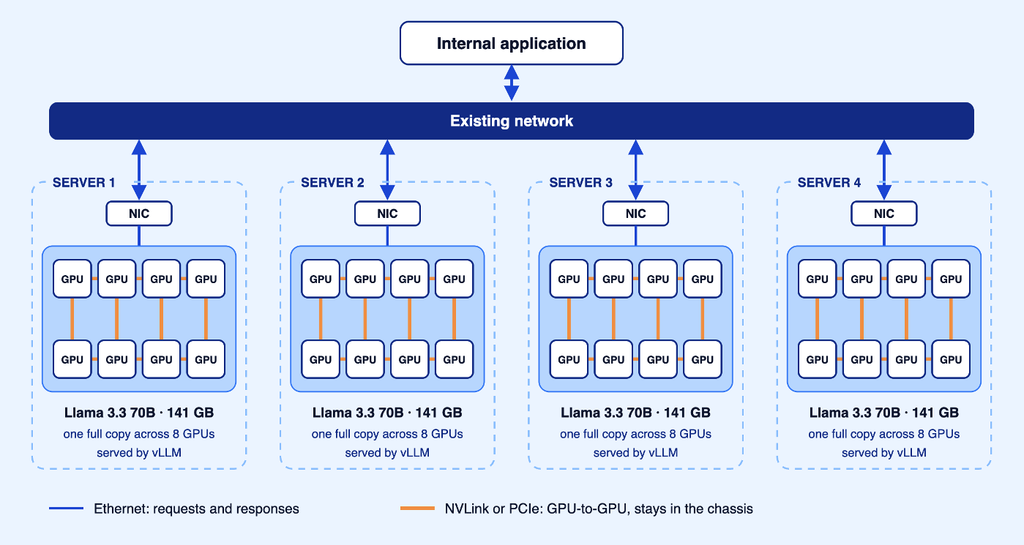
A 141 GB model sounds like a reason to buy faster switches. But if one server can hold the entire model and answer a request on its own, the switches never see the traffic between its GPUs. For someone using an internal chatbot, the more noticeable problem may be a model update elsewhere in the rack that makes a streamed answer pause mid-sentence.
In a November 25, 2026 design analysis, Sabina Anja, chief technologist at Broadcom, uses four servers with eight GPUs each to illustrate the distinction. Each server runs its own copy of Llama 3.3 70B using the open-source inference server vLLM. It is an example architecture for workloads such as an internal knowledge assistant or a private coding tool, not a benchmark. Anja’s recommendation is to check how the existing network handles two very different flows—long-lived responses and occasional bulk transfers—before buying a dedicated GPU network.
What stays inside the server
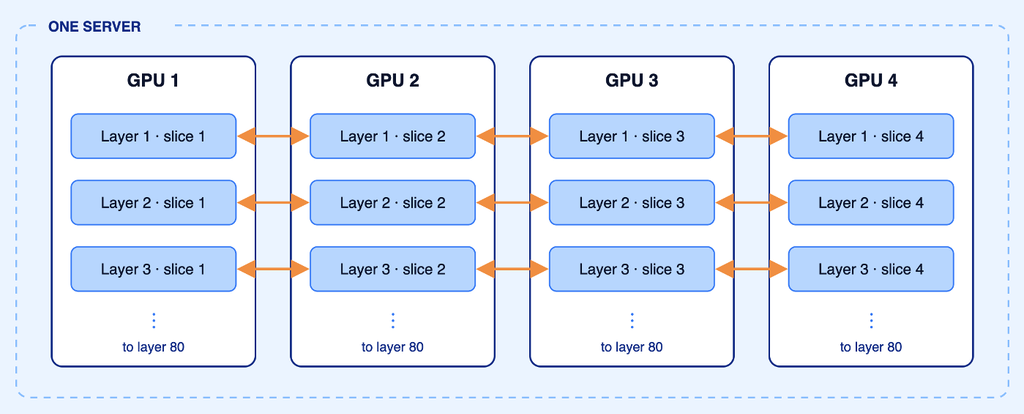
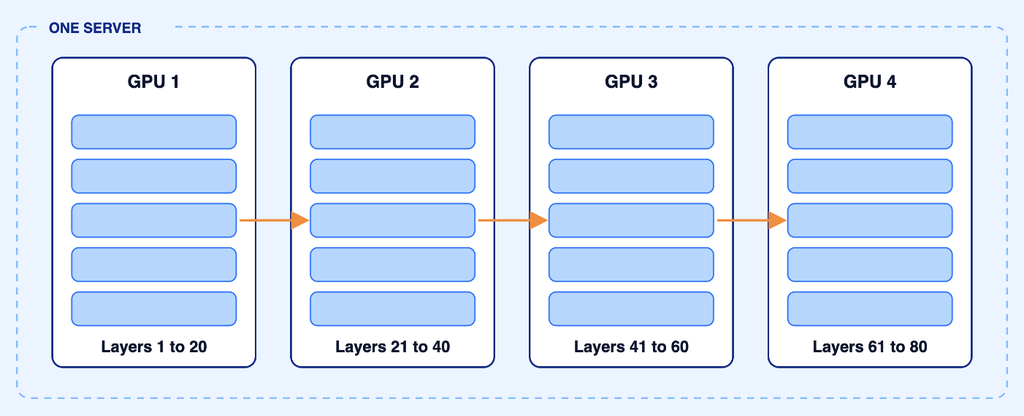
The roughly 141 GB model file is too large for a single 48 GB or 80 GB GPU, but it fits across the GPUs in one chassis. How vLLM divides the model matters for performance inside that server:
- Tensor parallelism gives each GPU a slice of every layer. The GPUs exchange partial results at every layer for every token, making the speed of the interconnect important. NVLink is suited to those frequent exchanges; PCIe can become a bottleneck.
- Pipeline parallelism gives each GPU a block of complete layers. Data moves between GPUs at the boundaries between blocks rather than at every layer. vLLM recommends this approach for cards without NVLink, such as the L40S, to reduce communication overhead and improve throughput on those cards.
In either case, the other three servers do not participate in that request. What crosses the network is the prompt, the streamed response and ordinary operational traffic such as logs and metrics. Model weights and container images move separately when a server needs to fetch them.
Size for open conversations, not just bandwidth
At 300 bytes per message and 50 messages per second, one response stream carries about 120 kbit/s. Even 1,000 such streams would total only about 120 Mbit/s. That is a bandwidth calculation, not a claim that one server can sustain 1,000 conversations: Anja estimates that each open stream holds 1–10 GB of GPU memory, depending on conversation length. With a few hundred gigabytes left after loading the model, the example server can accommodate tens to a few hundred streams at once.
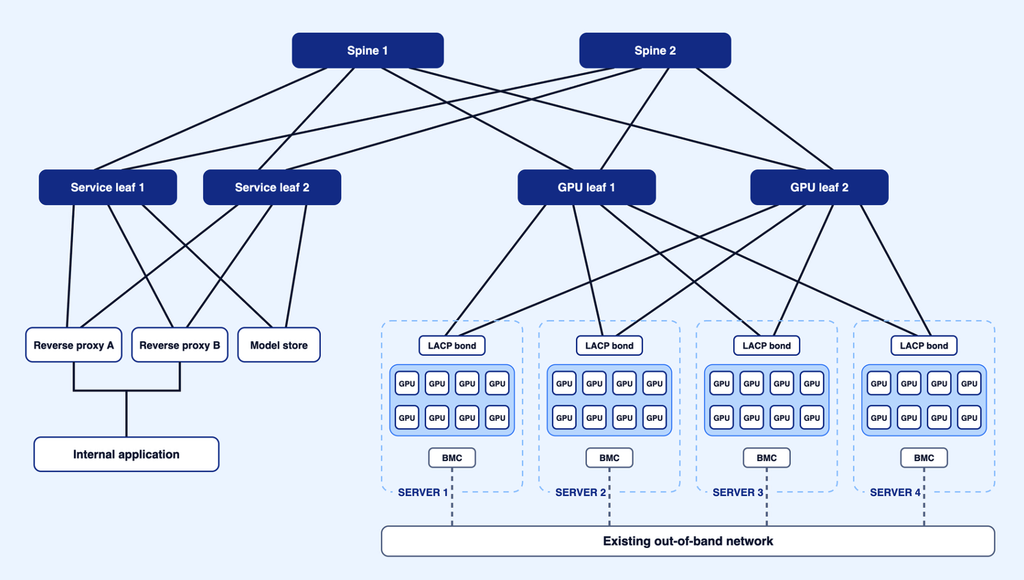
The proxy and firewall therefore need to handle the number and duration of sessions, not just their aggregate data rate. A single HTTP/2 connection can carry multiple requests of very different cost. A load balancer that sees only connections cannot distinguish them. Anja proposes a pair of reverse proxies that balance individual requests, favor less busy servers and use a consistent hash on a session identifier to keep a conversation on the server that has already cached its work.
Two proxy settings directly affect what a user sees. With nginx response buffering enabled, text can arrive in clumps rather than as it is generated. With the default read timeout, nginx closes a connection after 60 seconds of silence from the server. Anja recommends disabling response buffering and aligning proxy, firewall and network address translation timeouts with the longest acceptable pause. Readiness checks should also establish that the model has loaded: she recommends probing vLLM’s /v1/models rather than relying on an open port or on /health, which the llm-d project documents as a process check.
Keep model updates from delaying replies
A 141 GB transfer takes about 19 minutes at 1 GbE, 113 seconds at 10 GbE or 45 seconds at 25 GbE. Those are line-rate estimates that exclude protocol and storage overhead. The important question is not just how long the destination server waits: one transfer can occupy an entire 10 GbE top-of-rack uplink while other servers in the rack are trying to send replies.
Before adding hardware, Anja recommends checking uplink utilization and oversubscription, available ports, and quality-of-service support on both access ports and uplinks. Her proposed design connects each server to a pair of existing leaf switches over 10 or 25 GbE links. Only the reverse proxies should be able to reach the inference API port. Model storage traffic uses a separate logical segment, though both segments still share physical uplinks.
On those shared links, the design gives interactive API traffic a queue with guaranteed bandwidth or capped priority, separate from network control traffic. Bulk model transfers get the lowest queue weight and a rate limit at the model store. On a VXLAN network, operators also need to verify that the traffic-class marking is copied to the outer header; otherwise, spine switches cannot distinguish a streamed reply from a model download.
The simplest way to reduce contention is to avoid repeat transfers. Anja recommends fetching weights once into an internal store, keeping a copy on local NVMe storage in each server, and updating one server at a time. A process restart can then read from disk; the weights need to cross the shared network only for installation or a version change.
When a dedicated GPU network becomes relevant
Adding another independent replica does not, by itself, put GPU-to-GPU exchanges on the network. The design needs reassessment when serving one request requires GPU data to cross between servers. That happens if the model outgrows one chassis, but model size is not the only trigger: vLLM also has an experimental mode that passes cached state between instances. Fine-tuning across multiple servers introduces inter-server exchanges as well.
For distributed serving, vLLM recommends InfiniBand-class adapters and warns that its inter-server traffic is unencrypted. A dedicated network using remote direct memory access then merits consideration. Until the workload requires those exchanges, Anja’s example makes a narrower case for investment: protect response streams on the links they actually use rather than buying 400 GbE ports for GPU traffic that stays inside the server.