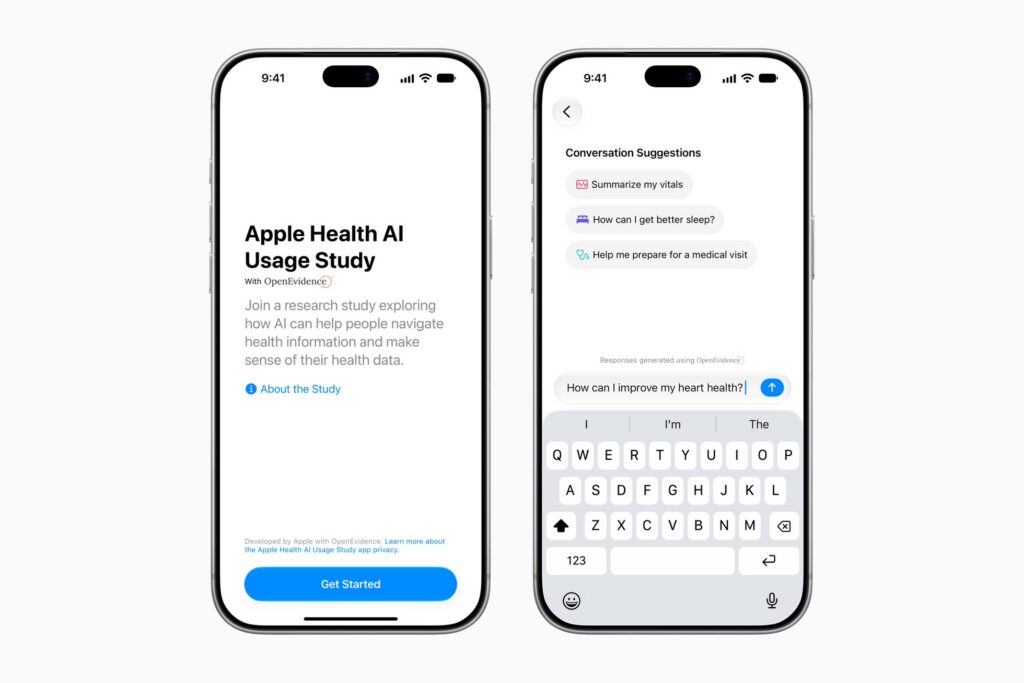
Reported November 16, 2026. Apple announced the Apple Health AI Usage Study on November 15, partnering with clinical AI platform OpenEvidence to recruit up to 200,000 people in the US. The study will examine how participants use and assess a conversational tool for everyday health questions; it is not a test of whether the tool can diagnose or treat medical conditions.
Participants must be at least 21, live in the US and have an Apple Intelligence-capable iPhone—an iPhone 15 Pro or a qualifying newer model—running iOS 26 or later. Recruitment began when the study app became available on the App Store. The research is expected to run for more than 12 months.
In the dedicated iOS app, participants can ask questions and rate answers for accuracy, detail and relevance. OpenEvidence supplies the medical AI technology, with answers citing peer-reviewed clinical literature. Participants may choose whether to share HealthKit information, such as resting heart rate, activity, sleep or lab results, so researchers can examine whether personal data affects how relevant and understandable the answers are. The study will also explore whether health AI helps people prepare for medical appointments.
According to The Verge, the app does not integrate Siri or Apple Intelligence: interaction is primarily by text, although iOS keyboard dictation is available. Apple says study data will not be used to train AI models, and participants control whether to share HealthKit metrics or survey responses. The app includes safeguards that direct some concerning questions toward a healthcare provider or other resources. It is not intended for diagnosis or treatment and does not replace professional medical advice.
Source: ithome.com (originally published 2026-11-16 14:48 UTC+8)