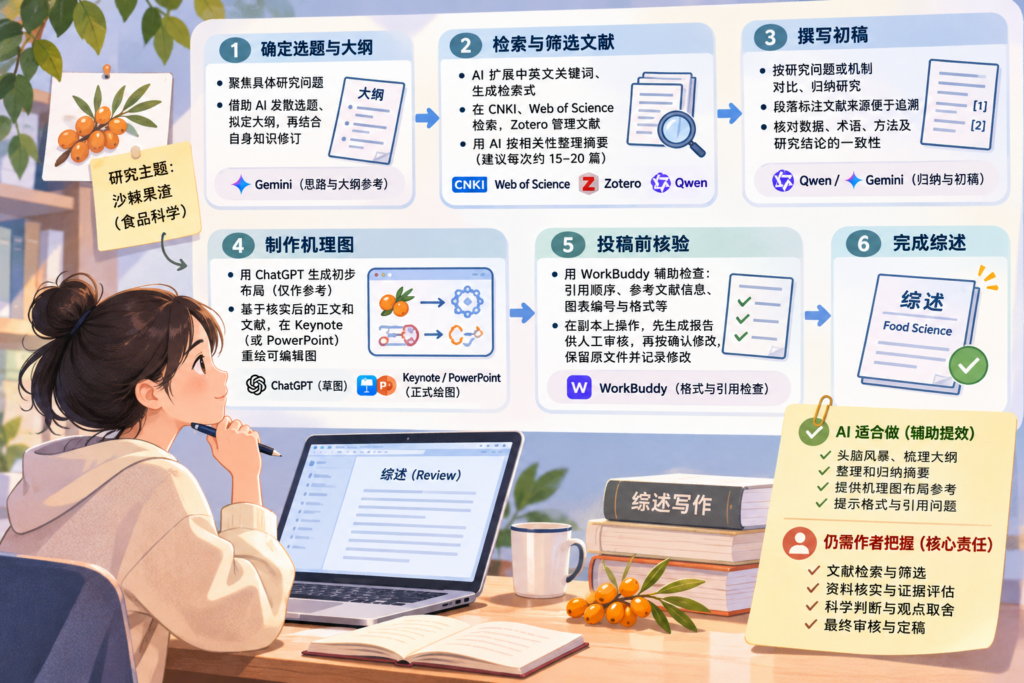
In a November 13, 2026, account published by 少数派, food-science graduate student 胡拉图说 describes a workflow for preparing a review article that was accepted by Food Science and published online. The author’s central point is that AI can help organize repetitive work, but it cannot take responsibility for selecting a worthwhile topic, interpreting research or verifying a manuscript.
The workflow begins with a narrow research question. Drawing on their work on sea buckthorn pomace, the author used Gemini to explore possible review topics and draft an outline. They then checked and revised that outline against their own knowledge. For references, the author distinguishes foundational papers, representative studies, recent work and studies with conflicting findings rather than selecting papers by publication year alone.
Next came database searching and screening. AI helped expand Chinese and English keywords and draft search expressions, but the author ran the searches in CNKI and Web of Science and collected potentially relevant papers in Zotero. They exported Zotero item reports containing titles, authors and abstracts, then used Qwen to sort papers by relevance and identify questions that required reading the full text. The author suggests processing roughly 15–20 abstracts at a time to reduce missed details.
For drafting, the author asked AI to compare studies by research question or mechanism rather than rewrite abstracts one by one. Draft passages carried source identifiers so claims could be traced back to the papers. The author then checked numbers, terminology, experimental methods and apparent conflicts against the underlying literature. An abstract-based draft, in this workflow, is a starting point—not a substitute for reading the evidence.
The same distinction shaped figure production. ChatGPT generated a preliminary layout for a mechanism diagram, but the author says its arrows, labels and depicted elements could be wrong. They rebuilt the figure in editable form using Keynote, checking it against the verified text and references. PowerPoint is suggested as a Windows alternative.
Finally, the author used WorkBuddy as a pre-submission checking aid for citation order, missing reference details, figure and table numbering, and formatting. Their proposed instructions tell the agent to work on a copy, produce a report for human review before making changes, preserve the original and log edits. The account describes this as the author’s experience with one review, not a guarantee that an AI agent will reliably correct references or preserve formatting in other manuscripts.
The practical lesson is to assign tools bounded tasks—brainstorming, organizing abstracts, proposing layouts and flagging formatting problems—while keeping searches, source checks, scientific judgments and final approval with the researcher.
Original article: 少数派 — 研究生如何用 AI 辅助完成一篇综述:我的科研写作工具与实践经验