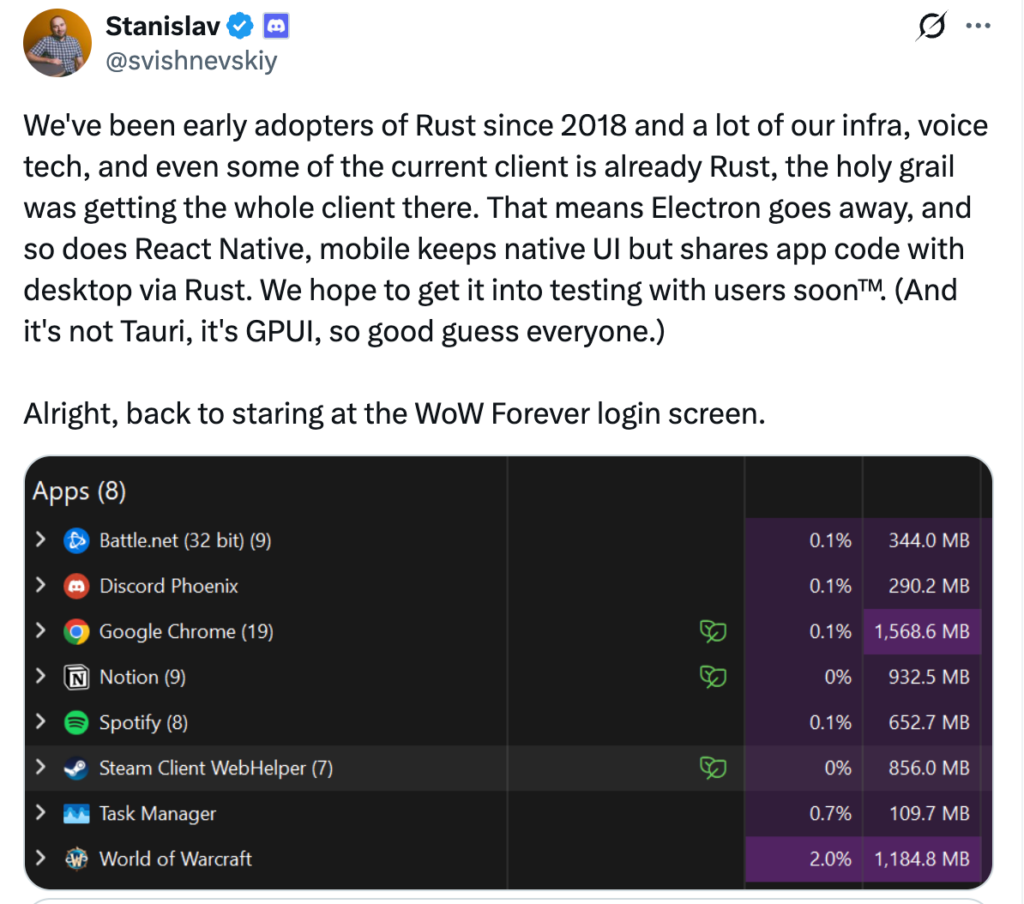
Discord co-founder and CTO Stanislav Vishnevskiy said on X that Discord is moving its client to Rust, removing Electron from the desktop app and React Native from mobile. InfoQ reported the announcement on November 10, 2026.
InfoQ said a Windows Task Manager screenshot he shared showed a build running as “Discord Phoenix” at about 290.2 MB of memory. Vishnevskiy later added that the client in that screenshot was signed into two accounts at the same time. The report contrasted that figure with the current Windows client, which it said can readily reach 1 GB or more after a user joins several servers. He described lower memory use as only one part of the change, said clicks felt extremely smooth, and pointed to startup speed as a reason he did not want to return to the old client. On mobile, he said the new client might be the most responsive app on his phone.
Asked about the web client, Vishnevskiy said there would be an HTML renderer, but the logic system would use WebAssembly rather than JavaScript. Discord has not announced a release date and has said only that it hopes to open user testing soon.
A commenter under his post congratulated Discord for finally discovering “Vibe Coding.” InfoQ said he did not answer that point directly. It also noted that Mark Smith, Discord’s vice president of engineering, had already publicly described an internal AI development platform called Vibeyard in March. According to Smith, as reported by InfoQ, internal apps that once took employees days or weeks to deliver could be deployed in about two minutes using Claude, CLAUDE.md, GitHub Actions, and Cloudflare infrastructure. InfoQ said many observers treated the client rewrite as AI-assisted coding, while Discord has not explicitly said that.
Earlier memory fixes, including an auto-restart test
InfoQ described Discord’s memory problems as long-running, including cases that reached 4 GB and an experiment with automatic restarts.
In October 2025, Discord began a focused investigation of the Windows client. By December 2025, the team had fixed at least nine issues tied to memory leaks, deadlocks, and buffer overflows, and had added telemetry and memory-analysis tools. Discord said normal use was usually under 1 GB, while some users still saw abnormal usage above 4 GB. Some cases involved the operating system, drivers, and hardware, and required outside partners to diagnose.
After that round of fixes, Discord reduced P95 memory use by about 5%. InfoQ said that was still not enough for people who leave the app running and switch channels and servers often.
Late in 2025, Discord engineers explained a performance experiment on Reddit. If the Windows client exceeded 4 GB, it could restart itself after the user left the computer. To limit disruption, the client had to have been running for at least an hour, the user had to be away, there could be no active voice call, and the restart could happen only once a day. The team said it wanted to ease memory pressure for some users and collect more data on abnormal cases. Discord said at the time that this was a temporary measure, not a lasting fix.
InfoQ said the decision drew mixed reactions: some users welcomed the effort, while others argued that a chat app needing an automatic restart already showed how serious the performance problem was.
Optimization inside Electron and React Native
Discord then kept tuning the existing stack. On September 8, 2026, it reported another set of changes. The desktop app moved to Electron 42; after adjustments to some calls, median CPU use fell by about 17%, while median memory use rose by about 4%. On mobile, a React Native upgrade cut average CPU use by about 5% on Android and iOS and shortened average startup time by about 5%.
InfoQ read those results as evidence that Discord had already spent substantial effort on Electron, rather than rewriting after a single incident, and that the old architecture still forced trade-offs between metrics. It noted that the issue is especially sensitive because Discord often stays open in the background during games, streams, or screen sharing, so extra CPU and memory can compete with those applications.
Why Rust, and why not Tauri
Vishnevskiy said Discord began adopting Rust in 2018. Much of its infrastructure, its voice technology, and some existing client code already use Rust, and moving the whole client had long been a goal.
In 2020, Discord published an engineering post on moving a core backend service, Read States, from Go to Rust. The service records which channels and messages a user has read. Discord was handling billions of read states, with heavy cache updates and database writes. The Go version was usually fast, but InfoQ said a clear latency spike appeared almost every two minutes. Engineers traced it to the garbage collector scanning a large LRU cache. Tuning garbage-collection settings and shrinking the cache did not solve the tail latency; a smaller cache meant more database reads. Discord rewrote the service in Rust, whose ownership model manages memory at compile time without a conventional garbage collector. Cached objects could be released when no longer used, removing the periodic GC pauses, and the team then adjusted cache structure and capacity. Discord also said the early Rust async ecosystem was not mature enough, so the migration created extra engineering work.
For the new client UI, some developers guessed Discord would use Tauri, which is Rust-based but typically renders with the operating system’s WebView and still uses HTML, CSS, and JavaScript. That approach can avoid shipping a full Chromium runtime while keeping web-development tools. Vishnevskiy said Discord did not choose Tauri and is using GPUI instead.
GPUI began with the team behind the Zed editor. It is a Rust interface framework that uses GPU-accelerated rendering, so interface and interaction logic can be written directly in Rust rather than packaged as a web UI. Vishnevskiy said the new client should look and function largely as it does now, but as a native app, with the system WebView used only for specific features such as YouTube and Activities.
A Discord developer involved in the work said the team had heavily modified Zed’s GPUI and that the version in use was close to a private fork. Discord hopes to work with Zed and contribute some changes upstream.
On mobile, Vishnevskiy said iOS had used React Native from the start, and Android moved to React Native several years ago to narrow feature gaps with iOS. Discord plans to remove React Native gradually, but not by copying the desktop interface onto phones. iOS and Android would keep separate native interfaces and share core application code with the desktop client through Rust.
Limits InfoQ highlighted
InfoQ argued that Rust and GPUI are not cost-free. Rust’s memory safety can prevent many memory errors, but it does not by itself stop leaks caused by application logic, oversized caches, or GPU memory use. GPUI’s ecosystem is less mature than Electron and the browser stack, so Discord would have to maintain platform work such as input methods, text selection, window management, accessibility, and operating-system integration. A heavily modified fork also implies ongoing maintenance and synchronization costs.
Accessibility was singled out. Chromium has long-standing support for mechanisms such as Windows UI Automation and macOS accessibility APIs. GPUI has accessibility approaches, including AccessKit, but InfoQ said the presence of interfaces does not mean a finished app immediately offers complete screen-reader and keyboard-navigation support. It also said GPU-accelerated rendering does not automatically make every interface action faster; scheduling, fonts, GPU drivers, and platform compatibility still matter. In InfoQ’s view, the hard part is reproducing the whole product reliably on the new stack.
Reaction, and what remains disputed
InfoQ said many developers welcomed the decision. One hoped other companies, especially Slack, would follow. Another said it would at least be useful if the change pushed engineers to treat memory and CPU use more seriously. The report framed that reaction against a broader complaint that Electron makes cross-platform Windows, macOS, and Linux apps easier to build, but ships Chromium and leaves users with several apps each consuming a lot of memory.
One quoted view was that a client aimed at games and livestreaming should use as little CPU as possible so it does not interfere with a running game. Zack Shutt was quoted welcoming a company giving memory back to users during a memory shortage. InfoQ also reported complaints that Electron’s cross-platform compromises matter more when people run local models, and that Electron is no longer a good fit once AI can help web developers do native work.
Investor Guillermo Flor was quoted saying local-tool stacks are converging on Rust interfaces that can run alongside local model runtimes. He described the opportunity as making an AI agent available without overloading a laptop: fast startup, enough resources left for the model, and a foreground interface that stays responsive while an agent works in the background. Another developer argued that companies once accepted extra memory use from React, Electron, and JavaScript because native development cost more staff time, and that large language models and agents now lower the cost of writing, profiling, and migrating code. That developer also criticized Claude and GPT desktop apps for using web-based wrappers. InfoQ noted that some local AI workbench developers have already chosen Tauri and Rust to shrink installers and improve startup, while others pointed out that a light interface does not help much if a background agent runtime still uses hundreds of megabytes.
Not everyone blamed Electron. Some developers told InfoQ that its main value is letting one team maintain several platforms at relatively low cost, which still matters for products that iterate quickly and need broad coverage. Other users said Discord should simplify the product itself—commercial entry points, recommendations, pop-ups, and extra interface elements—and that a Rust base will not keep resource use or the experience improving if features continue to accumulate.
A separate dispute concerns client modification. Discord has an active third-party mod scene, including tools such as Vencord, used to restyle the client, hide unwanted elements, or add features the official app does not offer. Electron’s web technologies made changes through JavaScript and CSS comparatively easy. After a move to Rust and GPUI, those methods may no longer work, and InfoQ said performance gains may not offset the loss of customization for people who rely on plugins and themes. Some users worried the rewrite could make third-party modifications easier to restrict, and suspected that was one motive. A Discord developer working on the rewrite later said the team’s priority is performance and a better experience.
Original article: InfoQ
Links cited by that article: